


BLOG
How Long Do Cigars Last? A Practical Guide to Shelf Life, Storage, and Aging


A premium cigar can be wonderfully resilient, or surprisingly fragile. One week in the wrong environment might leave it dry, cracked, and harsh. The same cigar, kept under proper conditions, can stay smokeable for years and in some cases improve with age. That gap is why “how long do cigars last” is really a storage question as much as a time question.
For collectors and everyday smokers alike, the answer depends on humidity, temperature, packaging, tobacco quality, and whether we’re talking about short-term freshness or long-term aging. At a retailer like SigAddict, where authentic Cuban cigars and premium non-Cuban brands are kept in controlled conditions before shipping, storage isn’t a minor detail, it’s the whole game. Let’s break down what actually affects cigar lifespan, what myths still float around the hobby, and how to keep your cigars fresh for as long as possible.
Key Takeaways
- How long do cigars last depends far more on storage than age, with premium cigars lasting years in stable conditions but drying out or declining within days to weeks in poor environments.
- Keep cigars around 65% to 72% relative humidity and 65°F to 70°F, because both low humidity and excess moisture can damage flavor, burn, and wrapper integrity.
- A well-maintained humidor can keep cigars fresh for several years or longer, while boxes, wrappers, and cellophane only slow moisture loss for days to a few months.
- Not all cigars improve with age, so proper storage, blend quality, and regular monitoring matter more than simply letting cigars sit.
- Check cigars often for warning signs like cracking, sponginess, mold, or beetle damage, and isolate any suspect cigar before it affects the rest of your collection.
- If a cigar dries out, rehydrate it slowly instead of rushing it, because quick moisture changes can split the wrapper and permanently reduce flavor quality.
Cigar Anatomy 101

A cigar is more than rolled tobacco. Its lifespan is tied to three main parts: the wrapper, the binder, and the filler. The wrapper is the outer leaf, and it’s the most delicate part. It contributes heavily to flavor and is usually the first thing to show storage damage. Beneath that, the binder holds the bunch together, while the filler contains the interior leaves that drive much of the body, strength, and complexity.
Because cigars are made from fermented natural leaf, they keep interacting with the environment after rolling. Tobacco absorbs and releases moisture constantly. That’s why humidity control matters so much: we’re not preserving a static object, we’re managing a living agricultural product.
As a general rule, most premium cigars are happiest around 65% to 72% relative humidity and roughly 65°F to 70°F. Plenty of smokers have their own sweet spot, some prefer 65/65, others lean closer to 69/69, but wild swings in either direction are what shorten a cigar’s usable life.
Too Little Humidity
When humidity drops too low, cigars dry out. The wrapper becomes brittle, oils fade, and the cigar may crack during handling or while smoking. Flavor also changes fast. Instead of balanced sweetness, spice, earth, cream, or cedar, we often get a hot, papery, one-dimensional smoke.
A mildly dry cigar might still be recoverable if we rehydrate it slowly. But if it has spent too long in arid conditions, the internal structure can suffer permanent damage. Essential oils dissipate, combustion becomes erratic, and even if the cigar looks better later, it may never fully regain its original character.
Too Much Humidity
Excess humidity causes a different set of problems. Cigars stored too wet can feel spongy, burn poorly, and tunnel or canoe. Draw resistance may increase because the filler expands. Worse, overly moist conditions create a much better environment for mold and tobacco beetles, two things no collector wants to discover in a humidor.
High humidity can also blur flavor. Instead of a clean, nuanced profile, the smoke may taste muddy or heavy. In other words, “moist” doesn’t equal “fresh.” A cigar can be technically hydrated and still be in bad shape.
Popular Misconceptions about Aging Cigars

One of the biggest myths in the hobby is that all cigars get better with age. They don’t. Some mature beautifully. Some plateau. Some fade. And some were blended to shine right away.
Another misconception is that age alone is valuable. It isn’t. A ten-year-old cigar stored poorly is just an old damaged cigar. Proper aging requires stable humidity, controlled temperature, minimal disturbance, and patience. Think of it less like leaving bread on a shelf and more like cellaring wine under the right conditions.
We also hear people say that a cigar with a dusty white coating is automatically a sign of quality aging. Not necessarily. Sometimes it’s harmless crystalline bloom, often called plume by smokers. Sometimes it’s mold. Confusing the two can ruin a whole collection.
How Can You Tell the Difference Between Cigar Plume and Cigar Mold?
Plume is typically a fine, dry, powdery, even-looking dust on the wrapper. It brushes off easily and usually doesn’t return immediately if storage is stable. Some enthusiasts debate how often true plume appears, but what matters in practice is this: it should not look fuzzy, wet, or web-like.
Mold is more dangerous and usually easier to spot once we know what to look for. It often appears as raised spots that can be blue, green, white, or gray, and it may look fuzzy or spread in irregular colonies. If you touch it with a cotton swab, it can smear rather than simply dust away. Mold often shows up first in overly humid environments or on cedar, labels, and foot areas where moisture lingers.
If we suspect mold, isolate the cigar immediately. Don’t just wipe it and put it back. Check nearby cigars, the humidor interior, and your humidity setup before the issue spreads.
How Long Do Cigars Last?
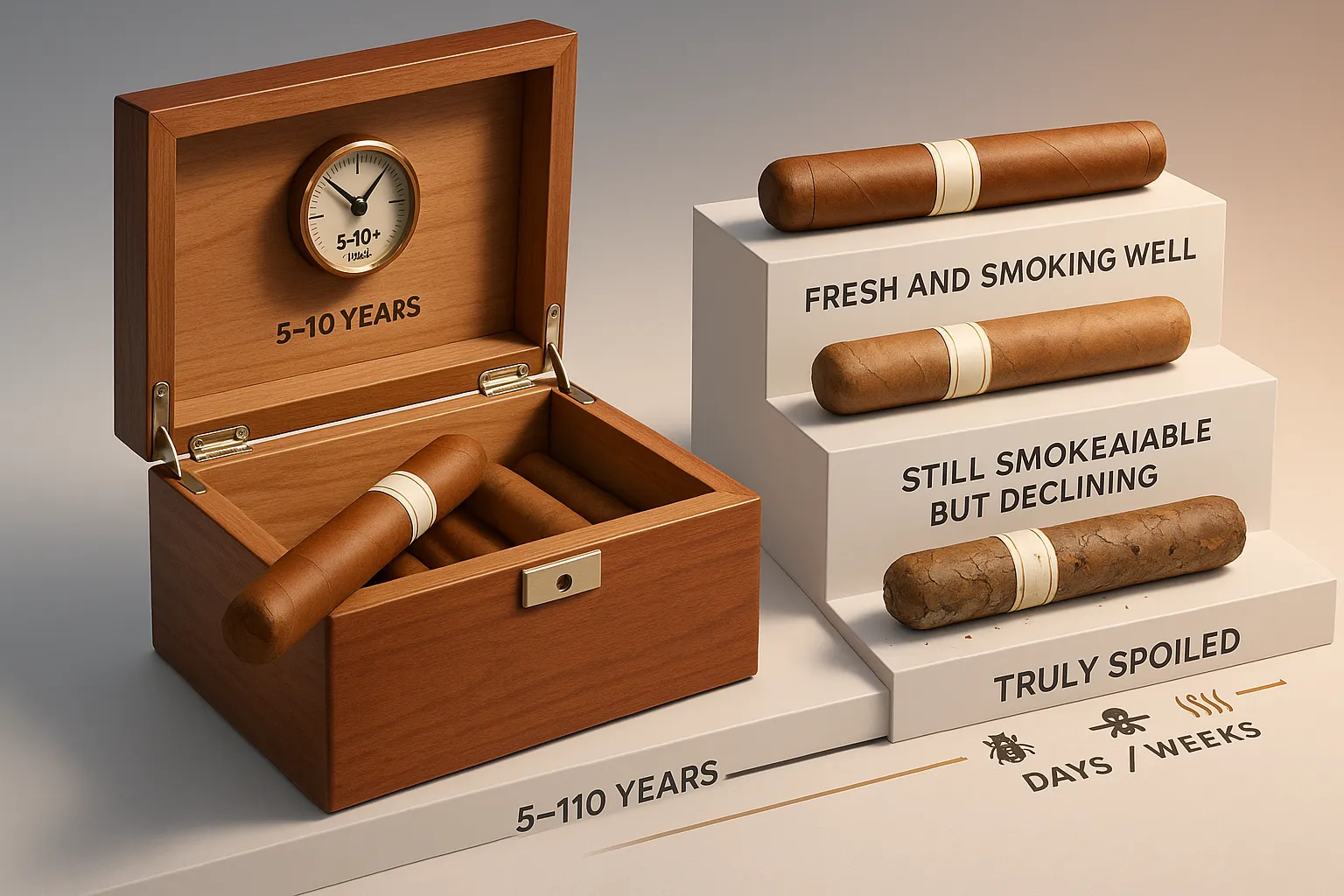
The short answer: it depends on how they’re stored.
Under proper conditions, premium cigars can last years. In ideal aging conditions, some can remain excellent for 5 to 10 years or more, though not every cigar benefits from that kind of wait. If they’re stored badly, they may begin to dry out or deteriorate in days or weeks.
So when people ask how long cigars last, we usually separate the answer into three categories:
- Fresh and smoking well: anywhere from weeks to years depending on storage
- Still smokeable but declining: common after improper storage or long exposure outside ideal humidity
- Truly spoiled or severely damaged: often the result of mold, beetles, excessive dryness, or heat
Factory packaging helps a little, but it’s not magic. A cigar on a shelf, in a pocket, or in a hot car won’t last nearly as long as one kept in a stable humidor. The practical shelf life of a cigar is less about the calendar and more about the environment we create around it.
How Long Do Cigars Last in a Humidor?

In a well-maintained humidor, cigars can last a very long time, often several years, and in many cases much longer. For everyday purposes, we can expect premium cigars to remain fresh indefinitely as long as conditions stay steady and the humidor is clean.
That doesn’t mean every cigar should be stored forever. Some blends are at their peak within the first year or two after purchase. Others, especially fuller-bodied or youthful cigars with ammonia still settling out, can become smoother and more integrated over time.
A few factors determine how successful long-term humidor storage will be:
- Stable humidity: usually 65% to 72% RH
- Stable temperature: ideally below 70°F to reduce beetle risk
- Air circulation: enough to avoid stale pockets of moisture
- Quality humidor seal: fluctuations are the enemy
- Regular monitoring: hygrometers drift, packs dry out, things happen
If we’re buying from a merchant that already stores cigars under optimal conditions, like SigAddict, we start from a much better place than if those cigars have already been sitting in uncertain retail conditions. That matters more than many smokers realize. A cigar’s “age” doesn’t tell the full story: its storage history does.
How Long Do Cigars Last Without a Humidor?

Without a humidor, cigars are on borrowed time. How much time depends on the packaging and the room conditions. In a cool, moderately humid environment, they may stay decent for a short while. In dry air or heat, they can degrade quickly.
As a broad rule, if we leave a premium cigar fully exposed to normal household air, it can begin losing ideal moisture within a few days and become noticeably dry within one to three weeks. In very dry climates, even faster.
How Long Do Cigars Last in a Box?
A standard cigar box offers some protection, especially if it’s cedar-lined, but it is not a true humidor. If the box is unopened and the surrounding environment is fairly stable, cigars may hold up for a few weeks to a couple of months. Once the environment is dry or warm, that timeline shrinks.
Boxes slow down moisture loss. They don’t stop it.
How Long Do Cigars Last in a Wrapper?
A simple paper or foil wrapper gives only limited defense. Wrapped cigars usually stay fresh just a bit longer than unwrapped ones, but not by much. We’d think in terms of days to a few weeks, not months, unless they’re also in a better storage setup.
How Long Do Cigars Last in Cellophane?
Cellophane helps regulate sudden moisture exchange and protects the wrapper from physical damage, but it doesn’t preserve a cigar forever. In decent room conditions, cigars in cellophane might stay acceptable for several weeks, sometimes longer, but they still dry out over time.
Collectors sometimes remove cellophane for aging, while others leave it on for protection. Either approach can work in a humidor. Outside a humidor, cellophane is helpful, but only somewhat.
How Long Do Cigars Last in a Sealed Tin or Tube?
This is where shelf life improves. A sealed tin or aluminum tube can preserve a cigar much longer than open-air storage, often for months and in some cases longer if the seal remains intact and the cigar was packed correctly to begin with.
That said, even a tube isn’t a guarantee of perfect aging. Seals fail, temperatures fluctuate, and the original packing humidity matters. Tubed cigars are great for travel and medium-term protection. For serious long-term storage, we still want a humidor.
How Long Do Cigars Last If You Try to Revive a Dry One?
A dry cigar can sometimes be saved, but “saved” doesn’t always mean “restored to original quality.” If a cigar has only been dry for a short period, we may be able to bring it back over several weeks using gradual rehumidification. The key word is gradual.
Trying to rush the process is a classic mistake. Put a bone-dry cigar straight into high humidity and the wrapper may split as the outer leaf expands faster than the filler. Better to start lower and let the cigar recover slowly.
Even when the texture improves, flavor may not fully return. Volatile oils and aromatic compounds can be lost permanently. So yes, a revived cigar may last and smoke again, but it may never be quite the cigar it once was.
Do Some Cigars Last Longer Than Others? Which Ones?
Yes. Some cigars are naturally better candidates for long storage and aging than others.
In general, well-made premium long-filler cigars last longer than budget machine-made cigars. Construction matters. Dense, properly rolled cigars with quality leaf tend to age more gracefully and maintain combustion better over time.
A few categories often stand out:
- Cuban cigars with strong aging potential: many classic marcas develop greater softness and complexity after years in proper storage
- Full-bodied non-Cuban blends: these often mellow and integrate nicely over time
- Thicker ring gauges: they can be a bit more forgiving because they contain more tobacco mass and lose moisture more slowly
- Tubed cigars: better protected during travel and short-term storage
On the other hand, very delicate cigars, lightly built cigars, or inexpensive dry-cured products may not reward long storage the same way. And flavored cigars are their own category altogether: aging isn’t usually the point there.
If we’re collecting with longevity in mind, it makes sense to buy from trusted sources with known storage standards and authentic inventory. That’s especially important for sought-after Cuban cigars, where authenticity and pre-shipment care can make or break the whole experience.
Do Cigars Improve With Age?
Sometimes, yes. Automatically, no.
Aging can smooth harsh edges, reduce sharp ammonia notes in younger cigars, and bring flavors into better balance. Strong pepper may soften. Earth, leather, cedar, cocoa, nuttiness, or cream may become more integrated. That’s the romantic side of cigar aging, and when it works, it’s terrific.
But not every cigar improves. Some lose vibrancy. Some become flatter and less expressive. A blend designed for immediate punch might become too muted after long rest. That’s why seasoned smokers often buy multiples and check one every year or so rather than assuming a perfect aging curve.
As a rule, cigars improve with age only when:
- they started as quality cigars,
- they were stored properly from day one,
- and the blend has enough structure to evolve.
In other words, age is an amplifier of good storage, not a replacement for it.
The Bottom Line: Keeping Cigars Fresh
If we want the simplest answer to how long do cigars last, here it is: as long as we store them well. A premium cigar can last days, months, or many years depending on humidity, temperature, and packaging.
The biggest mistakes are usually boring ones, letting cigars sit in dry room air, overheating them during travel, or assuming a box, wrapper, or tube is the same thing as proper storage. It isn’t.
Freshness is less about luck than consistency. Keep the environment stable, buy from reputable sources, and your cigars have every chance to smoke the way they were meant to.
How Can You Prevent Cigars Going Bad?
Prevention is straightforward, but it does require discipline.
First, store cigars in a quality humidor or a tightly controlled humidor alternative. Aim for a stable humidity range that suits your preferences, many collectors settle around 65% to 69% RH for cleaner burns and safer long-term storage.
Second, keep temperatures in check. Once temperatures climb too high, the risk of tobacco beetle infestation rises. Cool and stable beats warm and convenient every time.
Third, monitor rather than guess. Use a calibrated hygrometer. Check humidity packs or humidification devices regularly. Rotate stock once in a while if your setup needs it.
A few practical habits go a long way:
- Buy from trusted retailers with controlled storage and authentic stock
- Avoid rapid humidity swings
- Don’t overcrowd your humidor
- Inspect for mold or beetle holes regularly
- Keep cigars away from direct sunlight, heaters, and hot cars
- Use sealed travel cases when transporting premium sticks
And maybe the most underrated tip: don’t hoard more cigars than you can realistically store well. A smaller collection in perfect condition beats a giant one in slow decline every single time.
Frequently Asked Questions About How Long Cigars Last
How long do cigars last when stored properly?
If you store premium cigars at about 65% to 72% relative humidity and 65°F to 70°F, they can stay fresh for years. In a well-maintained humidor, many remain smokeable indefinitely, although not every blend improves with long-term aging.
How long do cigars last without a humidor?
Without a humidor, premium cigars usually start losing ideal moisture within a few days. In normal household air, they often become noticeably dry within one to three weeks, and in hot or very dry climates, they can deteriorate even faster.
Do cigars last longer in cellophane, boxes, or tubes?
Yes, but each offers limited protection. Cellophane may help for several weeks, a standard box can sometimes preserve cigars for weeks to a couple of months, and sealed tins or tubes often last months. For true long-term freshness, a humidor is still best.
Can a dry cigar be revived, and how long does it take?
A mildly dry cigar can sometimes be revived over several weeks with slow, gradual rehumidification. Rushing the process can crack the wrapper. Even if the cigar feels better afterward, lost oils and aromas may not fully return, so quality may still decline.
Do cigars improve with age, or do they just last longer?
Some cigars improve with age, but not all of them. Aging can soften harsh notes and integrate flavors when the cigar is high quality and stored correctly from day one. Others may plateau or fade, so age helps only when storage conditions are consistently right.
What is the best way to keep cigars fresh for as long as possible?
The best way to keep cigars fresh is to store them in a clean humidor with stable humidity and temperature, ideally around 65% to 69% RH and below 70°F. Use a calibrated hygrometer, avoid sudden swings, and keep cigars away from heat and direct sunlight.